1991: Civilian Defies Tank in Osijek

On this day in 1991, as the Yugoslav People's Army advanced into Osijek, Croatia, an unnamed civilian stepped into history by placing his car directly in the path of an oncoming tank. The driver sat alone in his vehicle, refusing to move as the armored column approached, a moment of individual defiance against overwhelming military force that would become one of the most powerful images of Croatian resistance. The tank did not advance. The man survived, and the photograph or eyewitness account of that confrontation spread across the world, transforming a single act of courage into a symbol of a nation's struggle for independence.

The context was the violent collapse of Yugoslavia. Croatia had declared independence on June 25, 1991, and the Yugoslav People's Army, dominated by Serbs and loyal to the federal government in Belgrade, began military operations to prevent secession. Osijek, a major city in eastern Croatia with a substantial Serbian minority, became a flashpoint. By late summer and autumn of 1991, the JNA launched a siege and assault on the city, forcing thousands of civilians to flee and leaving much of it in ruins. The war would ultimately claim thousands of lives across the region and reshape the map of Europe.
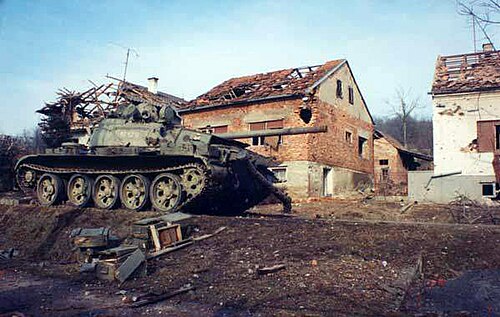
That unnamed man's act of placing himself between a tank and his city embodied the resistance of ordinary Croatians who had no tanks or air force but possessed something the world could not ignore: moral clarity and civilian courage. The image, whether frozen in a photograph or preserved in memory, echoed the Tank Man moment from Tiananmen Square in 1989, reminding the watching world that individual acts of defiance against military aggression retain their power to move hearts and shape how history is remembered. By 1995, when the war ended, Croatia had secured its independence, though at tremendous human cost.