Mandelbrot Set: Fractals from Simple Math
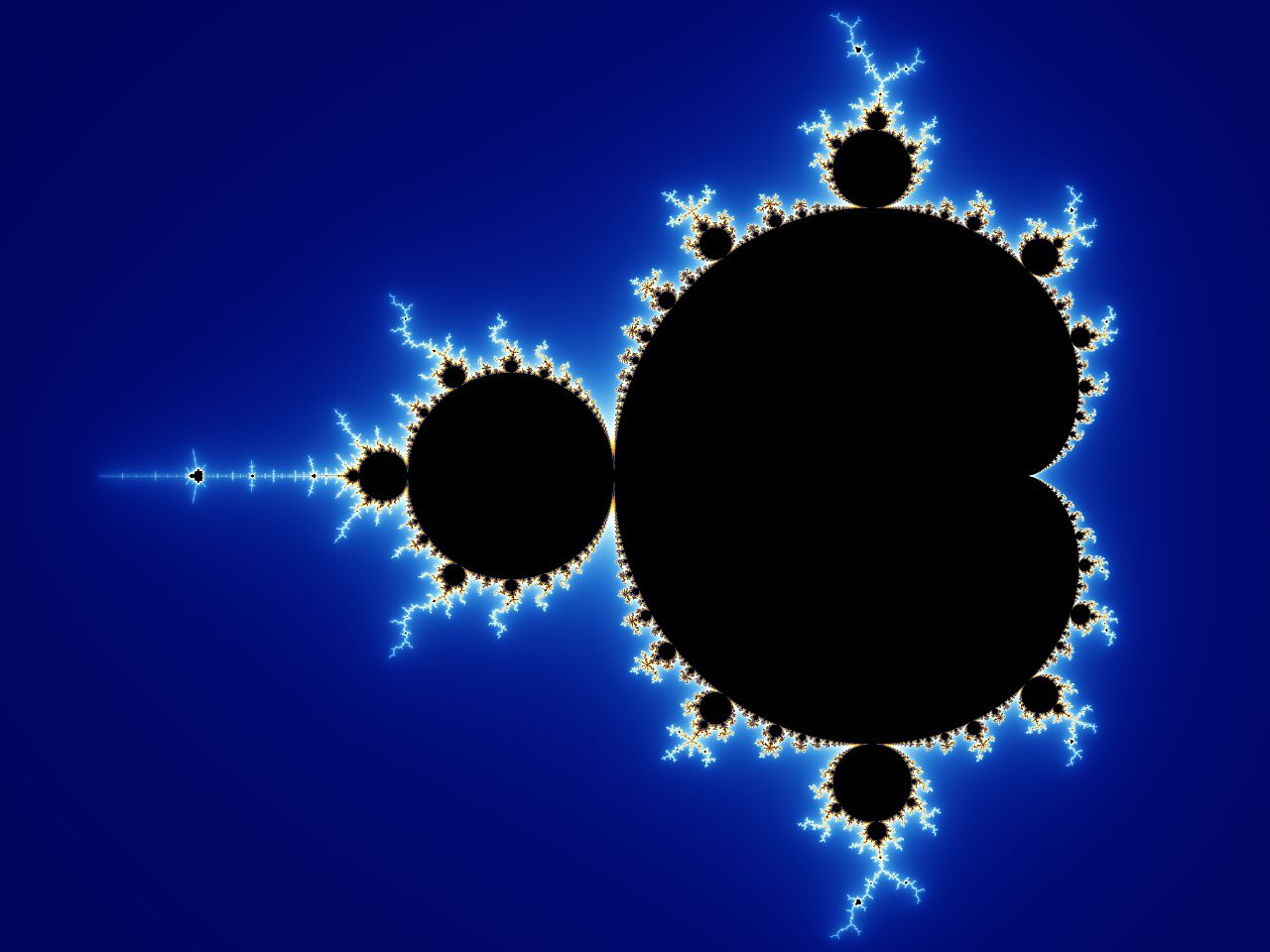
In 1978, mathematicians Robert W. Brooks and Peter Matelski drew something strange: a shape with a boundary so complicated that it never simplified, no matter how close you zoomed in. Two years later, in 1980, Benoit Mandelbrot created stunning high-resolution images of this object while working at IBM's Thomas J. Watson Research Center in Yorktown Heights, New York, and the mathematical world was captivated. The shape that bears his name, the Mandelbrot set, is born from one of the simplest equations in mathematics: f(z) = z² + c, where z and c are complex numbers (numbers with both real and imaginary parts, like 3 + 2i).

Understanding the Mandelbrot set requires only a willingness to repeat the same operation over and over. You start with z = 0 and pick any complex number c. Then you apply the function again and again: square your result and add c, then square that result and add c again, and again, and again. For some numbers c, this sequence climbs higher and higher toward infinity. For others, it stays bounded, never escaping beyond a certain distance from the origin. The Mandelbrot set consists of all the complex numbers c for which this endless iteration never runs away to infinity. These "safe" numbers c, when plotted on a two-dimensional plane called the complex plane (with the real part on the horizontal axis and the imaginary part on the vertical), create the famous shape.

What makes the Mandelbrot set so extraordinary is its boundary: a fractal curve that reveals infinitely intricate detail. Imagine zooming into the edge of the shape with a microscope, expecting to see a smooth line. Instead, you discover tiny copies of the entire set sprouting from that edge. Zoom in further and you find more copies, spiraling and twisting in patterns that never end. The "style" of these repeating patterns changes depending on which section of the boundary you examine. Some regions sprout perfect miniature copies; others burst into delicate spirals or elaborate tentacles. This property, containing scaled copies of itself at all magnifications, defines what mathematicians call a fractal.

To create a picture of the Mandelbrot set, mathematicians use computers to test thousands or millions of complex numbers c. For each number, they perform the iteration and count how many steps it takes before the sequence's absolute value (its distance from zero) exceeds some threshold, like 2. Numbers that never cross the threshold belong to the set itself and are typically colored black. Numbers that escape are colored based on how quickly they fled, creating the spectacular rings of color that surround the black region in the images you may have seen. Different color schemes reveal different details of the escape speed, turning mathematics into visual art.

The Mandelbrot set matters because it showed that breathtaking complexity can emerge from absurdly simple rules. Before computers were fast enough to calculate billions of iterations, no one could have imagined just how intricate z² + c actually was. Today, the set appears throughout computer graphics, physics, and chaos theory. It demonstrates that nature's fractals, coastlines, mountains, clouds, blood vessels, might follow similarly simple underlying rules. The Mandelbrot set remains one of mathematics' most famous achievements: an infinite labyrinth discovered by following a single, straightforward instruction indefinitely.