Tower of Hanoi: The Puzzle That Never Ends
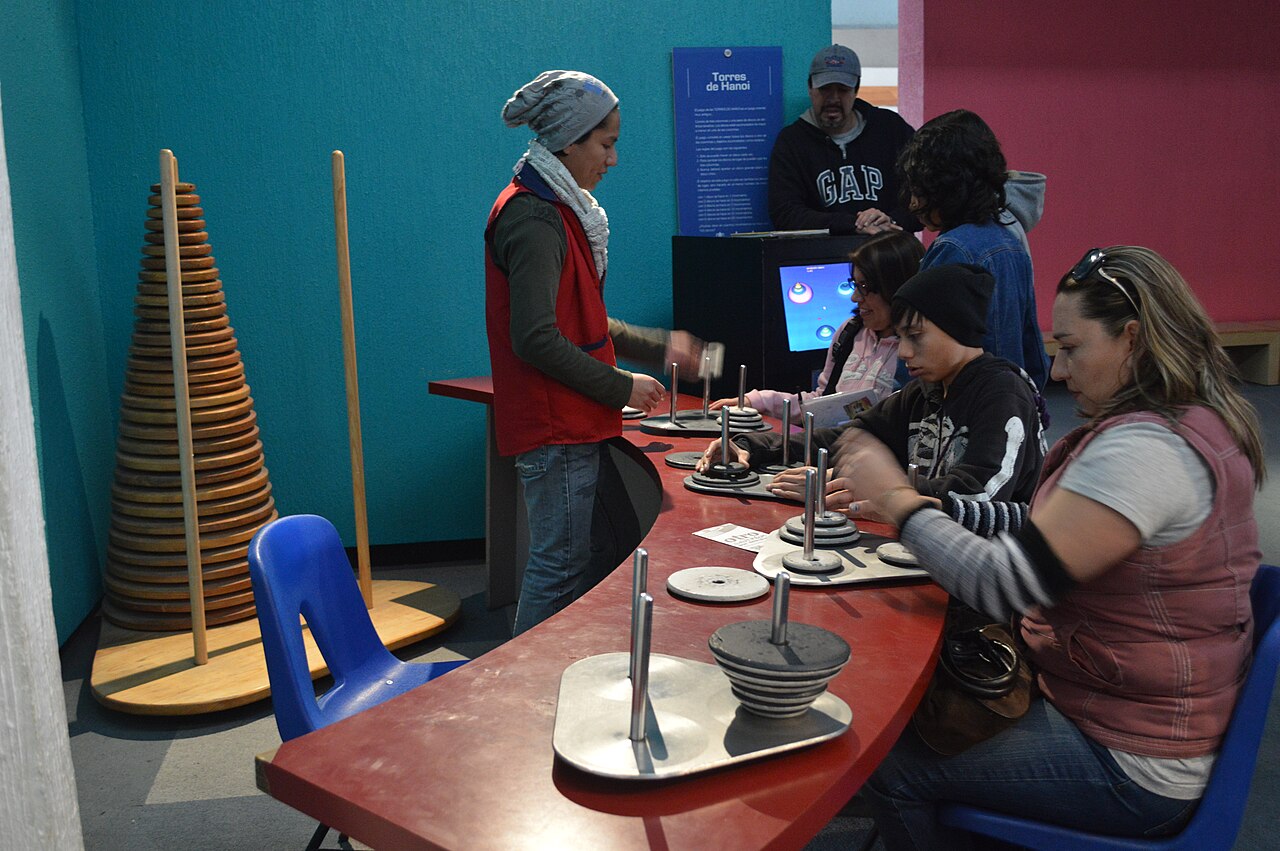
Picture three wooden rods standing upright on a table, and stacked on the leftmost rod: a large wooden disk, a medium disk balanced on top of it, and a small disk balanced on the very top, like a cone. Your job sounds simple: move that entire stack to the rightmost rod. But there's a catch, and it's absolute. You can move only one disk at a time, you can never place a larger disk on top of a smaller one, and you have to keep the structure balanced throughout every single move. This puzzle, called the Tower of Hanoi, has baffled and delighted mathematicians, computer programmers, and puzzle lovers for over a century because it looks easy but reveals itself as a master lesson in logical thinking.

The Tower of Hanoi was invented in 1883 by French mathematician Édouard Lucas, who published it under the pen name "N. Claus de Siam", an anagram of "Lucas d'Amiens." Lucas attached a romantic legend to make it more mysterious and memorable: he claimed that in a temple in Benares, India, Brahmin priests had been working on an ancient version of this puzzle with 64 golden disks and three diamond rods ever since the world was created. According to the legend, when the priests finally moved the last disk to its destination, the world would end. This story was entirely fictional, but it stuck around so well that people still call the puzzle by names like the Tower of Brahma or the Problem of Benares Temple. The puzzle became wildly popular, spreading through Europe and America as a parlor game, often manufactured as a wooden toy in the late 1800s, and later as a computer program in the 1960s.

Here's where the mathematics gets fascinating. With just three disks, you can solve the puzzle in seven moves. Try it yourself: move the small disk to the middle rod, the medium disk to the right rod, the small disk on top of the medium disk, the large disk to the middle rod, the small disk to the left rod, the medium disk on top of the large disk, and finally the small disk on top of the medium disk on the right rod. You've done it in seven moves. The pattern holds for any number of disks, following a formula that French mathematician Édouard Lucas discovered: the minimum number of moves equals 2^n − 1, where n is the number of disks. With four disks, it takes 15 moves. With five disks, 31 moves. The number explodes exponentially.

What makes the Tower of Hanoi so powerful as a teaching tool is that it reveals how exponential growth actually works in practice. If those Brahmin priests really did have 64 golden disks, they would need 2^64 − 1 moves to complete the puzzle. That's 18,446,744,073,709,551,615 moves. If they made one move every second without stopping, it would take them roughly 585 billion years to finish, far longer than the current age of the universe. This puzzle shows you viscerally why exponential problems become impossible so quickly.
The Tower of Hanoi also teaches something deeper about problem-solving itself. The elegant solution uses what's called a recursive strategy: to move n disks from rod A to rod C using rod B as temporary space, you first move n−1 disks to the temporary rod, then move the largest disk to the destination, then move the n−1 disks on top of it. This breaks a seemingly impossible problem into smaller versions of itself. Computer scientists and programmers use this same recursive thinking to solve all kinds of complex problems. The puzzle has become a standard teaching tool in computer science classes, where students learn to write recursive computer programs by solving the Tower of Hanoi. It transforms an abstract concept into something you can hold in your hands and move piece by piece, making the logic visible and unforgettable.